

Quick Answer for Gulf Visitors
Is travel to Turkey allowed in 2026? — Yes. Travel is fully open from every country including all Gulf states, with no health restrictions, quarantine, or vaccine conditions.
Do Gulf citizens need a visa? — No. Citizens of Saudi Arabia, the UAE, Kuwait, Qatar, Bahrain, and Oman enter without a pre-arranged visa for stays up to ninety days.
What about Gulf residents of other nationalities? — It depends on citizenship: some nationalities qualify for an instant e-visa, while others must apply through a visa application center.
What are the basic entry conditions? — A passport valid for at least 150 days, a return ticket, proof of sufficient funds, and a accommodation booking.
The Overall Border Situation in 2026
The doors are open. No public-health requirements remain at entry: no vaccination certificate, no test, no quarantine, and airports in Istanbul, Antalya, Trabzon, Dalaman, and beyond run at full capacity. Gulf visitors top the Arab arrival charts every summer, and the tourism system is fully accustomed to hosting them from booking to departure.
"Allowed," however, does not mean "condition-free"; entry still follows the standard passport, visa, and stay rules, and that is where citizens and residents part ways. A Gulf citizen usually enters under the visa waiver, while a resident's path depends on their nationality's list position. This guide therefore splits the answer precisely by category and links you to detailed companions such as Turkey visa for Saudi citizens and Turkey visa for UAE citizens.
Entry Rules by Category
Citizens of the Gulf Cooperation Council
Entry is visa-free for ninety days within every 180-day period, with nothing but a valid passport. An entry card is stamped on arrival, and keeping it until departure is advisable. The waiver covers tourism and family visits; work and study require separate permits.
Gulf Residents of Eligible Nationalities
Many Asian and African nationalities residing in the Gulf qualify for the e-visa through the official visa portal under resident-friendly conditions: a valid Gulf residence, health insurance, and a return ticket. Approval usually arrives within minutes to twenty-four hours.
Nationalities Outside the E-Visa List
These require a sticker visa from the embassy or an authorized application center; locations and booking details are covered in the Turkey visa application centers guide, and for Kuwait specifically see Turkey visa center in Kuwait.
Comparison of Available Entry Routes
| Criteria | Citizen waiver | E-visa | Sticker visa |
|---|---|---|---|
| Who qualifies | GCC citizens | Eligible nationalities and residents | Non-eligible nationalities |
| Where issued | On arrival | Official website online | Application center or embassy |
| Typical issuance time | Instant | Minutes to 24 hours | 7-15 working days |
| Stay length | Up to 90 days | Usually 30 days | Depends on visa type |
| Approximate fees | Free | $50-60 | $80-120 with service |
| Multiple entries | Yes | Depends on nationality | Depends on type |
Border Conditions the Officer May Check
Passport validity remains the decisive condition: officers generally look for 150 days of validity from the entry date (five months), not the six months commonly repeated online. Beyond that, an officer may request a return or onward ticket, an accommodation booking or host address, proof of sufficient funds (a credit card or cash), and travel health insurance — not always enforced, but a practical shield. A tidy file of these documents on your phone turns the checkpoint into a two-minute stop.
Stay Duration and Overstaying
The waiver allows ninety days per 180-day period; anyone intending to stay longer must either exit and re-enter within the rule or apply for a residence permit through the government portal before the window closes. Overstaying triggers a fine at departure and can compromise future entries, and there is no friendly settlement once the violation is recorded.
Practical Tips for Gulf Visitors
Check your passport validity a month before travel, not a day before: the working requirement is truly 150 days, not one month. Residents: your e-visa is issued against your original passport, not your Gulf residence card, so enter the details of exactly the passport you will fly with. Print the e-visa even though it is electronic, because some airport counters ask for paper. Travelers combining other Turkish destinations can continue with the complete Turkey guide and the travel to Turkey overview for everything after entry.
Practical Info for Gulf Visitors
| Item | Details | Note |
|---|---|---|
| Passport validity rule | 150 days from entry | Five months, the working standard |
| Gulf waiver duration | 90 days per 180 days | Tourism and family visits |
| E-visa | Official portal only | Beware intermediary sites |
| E-visa fee | About $50-60 | Credit card payment |
| Health insurance | Strongly recommended | Cover the whole trip |
| When to apply | 7-30 days before travel | No months needed |
| Emergency number | 112 | Police and ambulance |
| Official portal | evisa.gov.tr | The only trusted source |
FAQ (12 Questions)
- Is travel to Turkey genuinely allowed in 2026 without restrictions?
Yes; borders are open to all eligible nationalities with no health restrictions, quarantine, or vaccine requirements, and the only standing rules are the usual passport and visa regulations.
- Do Saudi, Emirati, or Kuwaiti citizens need a visa?
No; citizens of all six GCC states enter visa-free for tourism stays up to ninety days with a valid passport.
- What passport validity is actually required?
The working standard at checkpoints is 150 days from entry, though carrying a passport valid six months is the safe buffer against any officer's stricter reading.
- I am a resident of Saudi Arabia with another nationality — what applies to me?
It depends on your citizenship; many nationalities qualify for the e-visa under resident conditions (valid residence and insurance), while others must file for the sticker visa through application centers.
- Is e-visa approval guaranteed?
Nearly certain when conditions are met and passport data is entered precisely; most rejections trace back to a wrong passport number, a date error, or double payment.
- How much does the e-visa cost?
Roughly fifty to sixty dollars depending on nationality, paid by credit card during application on the official portal — the only safe payment channel.
- Can I enter and stay longer than ninety days?
Not under the waiver; the rule is ninety days per 180-day period, and longer stays require a residence permit filed before expiry through the official government portal.
- What happens if I overstay?
A financial fine at departure that grows with the overstay length, plus a border-system record that can complicate your next entry — never build a trip around overstaying.
- Are return tickets and hotel bookings always requested?
Not always, but officers are entitled to ask; keeping the booking confirmation and return ticket on your phone shortens inspection and reassures the officer.
- Do children need separate procedures?
Yes; every child needs an individual passport (inclusion in a parent's passport no longer suffices), and the e-visa is issued per person, child or adult.
- Is entering by land from Georgia or Bulgaria different?
The rules are the same but checks take longer at land crossings; Gulf travelers usually fly, and land borders demand patience and orderly documents.
- Where do I verify the latest rule updates?
The final sources are the official visa portal and the foreign ministry; link details and steps are summarized in the official visa website guide and Turkey travel requirements.
Entry Routes in Detail
Gulf Cooperation Council Citizens
Saudi, Emirati, Kuwaiti, Qatari, Bahraini and Omani citizens are visa-exempt for 90 days per visit, extendable electronically through e-ikamet.gib.gov.tr with a valid reason (medical, temporary work, study). The ordinary passport is enough, with no pre-arrival procedure other than checking the passport is valid for 6 months and has at least one blank page. Total stay within 180 days cannot exceed 90 days, otherwise fines apply.
Residents of Exempt Nationalities
Residents in Gulf countries holding passports of nationalities like Morocco, Tunisia, Jordan, Lebanon and Algeria keep the same exemption as their home citizens, but need an e-visa or sticker visa depending on nationality. A Jordanian resident enters visa-free on the Jordanian passport, and a Moroccan resident likewise. Verifying Gulf residence status matters for nationalities needing visas, because Gulf residence speeds the application and opens additional routes.
Residents of E-Visa Eligible Nationalities
Nationalities such as Indian, Pakistani, Filipino and certain other groups can apply through evisa.gov.tr in minutes for $50-100, and the visa is usually issued within 24 hours. The e-visa is valid 180 days from issue and allows a 30-day stay per visit, with single or multiple entry. The full list of eligible nationalities is on the portal and updated periodically.
Residents Needing a Sticker Visa
Residents of Pakistan, India, Bangladesh, the Philippines, Iraq and Egypt (in some cases) need a sticker visa issued by the embassy or authorised visa centres. Processing takes 7-15 business days, fees run $50-200 by nationality and visa type, plus a $20-50 centre service charge. Incomplete files are returned, and repeat refusals weaken later applications, so careful preparation matters.
Special Cases and Restrictions
Some nationalities face additional restrictions or extended security approvals, and a few cannot enter Turkey at all. For residents of these nationalities the only solution is to apply from their country of origin or a third country that accepts them, expecting long waits. Updates change frequently, so always verify the official embassy site before travel.
Additional Details for Gulf Visitors
2026 Updates and Recent Changes
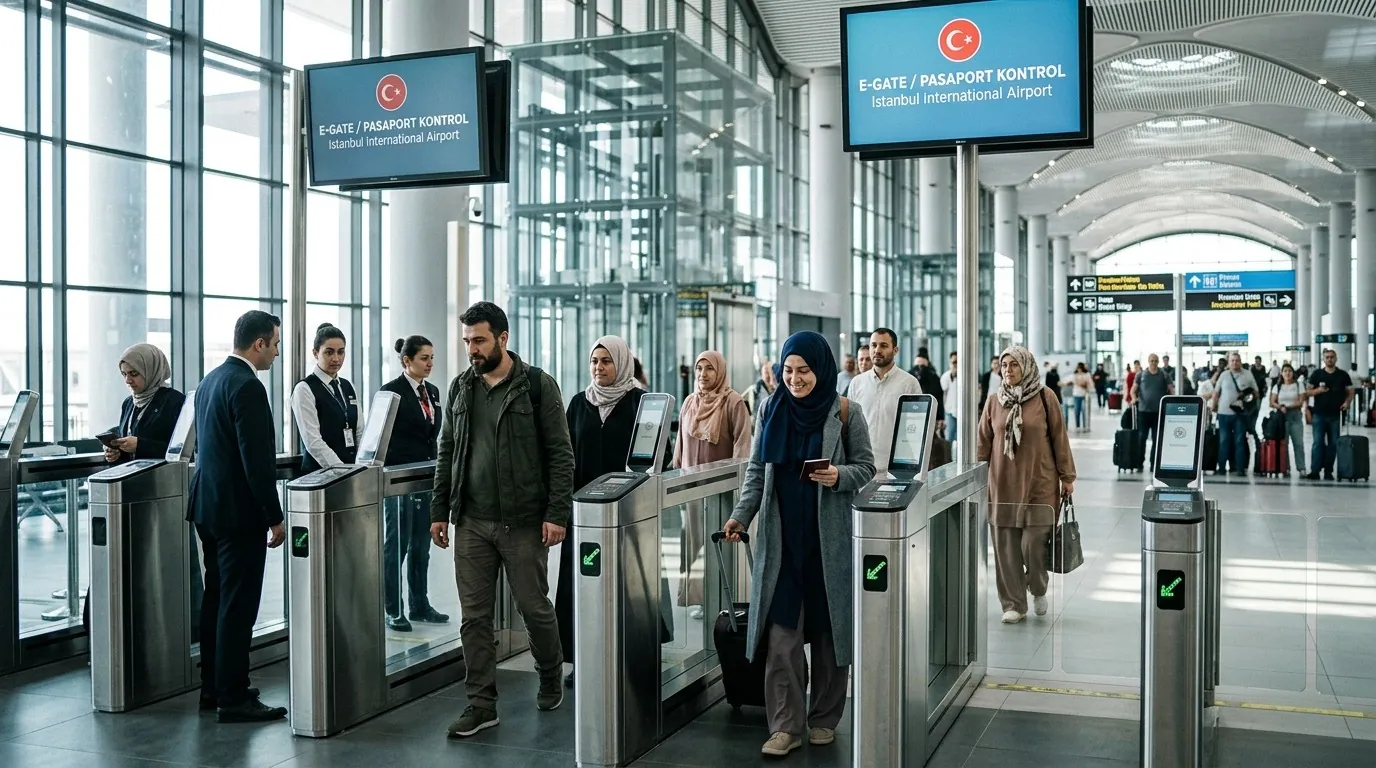
In 2026 the lists of e-visa eligible nationalities are updated, with some new additions and removals. The Gulf exemption continues without change. Customs procedures have become smoother thanks to electronic gates at major airports. E-visa processing time has dropped to 6-12 hours in most cases thanks to automation.
E-Visa Timing
Applications through evisa.gov.tr are open 24/7, but major updates happen overnight. Applying early in the morning gives you a chance of same-day processing. The e-visa is valid 180 days from the issue date, so apply close to your travel date. Travelling on an expired or near-expired visa exposes you to entry denial.
Cases That Need Special Review
- Medical treatment travel needs a Turkish hospital report
- Work travel needs a certified employment contract
- Study needs an acceptance letter from the university
- Family visit needs an invitation from the resident
Visas for Relatives of Gulf Citizens
A foreign wife of a Gulf citizen takes an e-visa or sticker visa by nationality. Children born in the Gulf take the father's citizenship in certain cases, otherwise they need separate procedures. First-degree relatives (parents, siblings) need an official invitation from the Gulf citizen.
Alternative Passports for Restricted Nationalities
In exceptional cases, citizens of restricted nationalities can apply from a third country that accepts them (such as Russia or some South American countries) and obtain an entry visa from there. This process is complex and time-consuming, but it is a last resort for those who cannot enter Turkey from their home country.
Overland Travel from Neighbouring Countries
Entry by land from Bulgaria or Greece is possible but slower. Land borders operate during specific hours, and customs procedures may take an hour. Overland travellers need the same passport and visa requirements. Some nationalities face restrictions on overland entry even if their e-visa is still valid.
Conclusion
Travel to Turkey in 2026 is allowed and easy for every Gulf category: citizens enter under the ninety-day waiver, eligible residents obtain an e-visa within minutes, and everyone else has a clear path through application centers. A small file — valid passport, return ticket, booking, insurance — turns entry into a two-minute formality. Once the rules are settled, arrange the trip itself: pick your accommodation, book private airport transfers, and reserve tours that fill your days with what deserves them.
Sources
Related travel guides

Ayder highlands 5-day itinerary 2026: a day-by-day plan for Arab families covering thermal pools, valleys, and Trabzon.

Ayder Trabzon distance 5-day itinerary 2026: a day-by-day plan for Arab families covering the transfer route.

Ayder Turkey weather 2026: monthly averages, rain patterns, best months to visit, and packing tips for Gulf families.
Ready to explore Turkey?
Voyago brings together hotels, tours and transfers to help you plan the perfect trip to Turkey.