
Quick Answer for Gulf Visitors
What does the Turkish flag mean? A white crescent and star on a red field: the red stands for the blood of martyrs and the sacrifices of the independence struggle, the white for peace and independence. Turks call it "Ay Yildiz" — the crescent and star.
How old is the current flag? In a nearly identical form since the Ottoman mid-nineteenth century; the Republic inherited it in 1923, and Flag Law No. 2994 of 1936 fixed its exact proportions.
What is the story behind the crescent and star? An ancient symbol of Anatolia and Mesopotamia carried by Ottoman banners for centuries — its most famous legend is the moon and a star reflected in a pool of blood after the Battle of Kosovo.
The Turkish Flag at a Glance
| Element | Detail |
|---|---|
| Local name | "Ay Yildiz" (crescent and star) and "Al Bayrak" (the red banner) |
| Colors | Red field + white crescent and star |
| Ratio | Length = 1.5 times the width (3:2) |
| Adoption | Ottoman form since the mid-1800s; Republic since 1923 |
| Flag law | No. 2994 of 1936 — regulates dimensions and use |
| Peak days | Republic Day October 29 and Victory Day August 30 |
The Crescent and Star: Older Than the Flag Itself
The crescent and star are not an Ottoman invention: the symbol appears on ancient Byzantine coins and on seals from Anatolia and Mesopotamia thousands of years old, and Constantinople itself carried crescent symbols before the conquest. The Ottomans inherited the emblem from the region's history and made it the mark of their state across the centuries — so the open crescent and five-pointed star remain Turkey's signature to this day.
For Gulf visitors the symbol feels familiar from Islamic architecture everywhere; what stands out is that the crescent on the Turkish flag opens toward the star in precise geometric proportions fixed by the 1936 law — not just any crescent and any star.
The Red Field: Blood of Independence
Red on the Turkish flag carries heavy meaning: it is read as the blood of the martyrs of the independence wars and of everyone who fell defending the land, from Gallipoli to the War of Liberation of 1919-1922. That is why Turks raise their flag with deep respect: it never touches the ground, it is saluted each morning in schools and offices, and it appears on every balcony during national holidays by the people's own initiative, not by state instruction.
From the Ottoman Banner to the Republic's Flag
The late Ottoman flag of the mid-nineteenth century carried a crescent and star on red in a form nearly identical to today's, so when the Republic was proclaimed in 1923 there was no need for a new flag: the emblem embraces the whole nation's history. In 1936, Flag Law No. 2994 laid down the exact engineering specifications — the crescent's diameter, the star's position and their distances — the legal text that governs the flag to this day.
The Legend of the Blood Pool
The most famous tale of the emblem's birth: after the great Battle of Kosovo in the fourteenth century, a wounded commander looked into a pool of soldiers' blood and saw the crescent moon and a star reflected beside it — and the image became the state's banner. The story is a folk legend rather than a historical document, yet it is part of Turkish schoolroom memory to this day, and it explains to visitors why Turks treat their flag's red with such seriousness.
Where to See the Flag at Its Finest
- Camlica Hill, Istanbul: giant flags fluttering above the Bosphorus from the city's highest terrace — the best single shot of flag and city together.
- Ships on the Bosphorus: every ferry and vessel flies the flag at its bow; a sunset cruise gathers hundreds of them in one frame.
- Anitkabir, Ankara: the founder's mausoleum, with its ceremonial guard and immense flag — capital details in the Ankara guide.
- Republic Day (October 29): streets, balconies and vehicles all carry flags; if your trip falls on it, you will see the year's fullest national decoration.
The Flag's Engineering, by the Numbers of 1936
The flag law is so detailed that designers follow it with ruler and calculator: the flag's width (G) is the unit of measure, length is 1.5 G, the outer circle of the crescent is half the width (0.5 G), the inner circle is 0.4 G with its center shifted slightly to create the crescent's opening toward the star, and the five-pointed star sits inside a circle of 0.25 G. These numbers define "Ay Yildiz" exactly — any crescent and star on red that breaks them is not an official Turkish flag.
The Turkish Flag vs the Flags of the Gulf: A Quick Comparison
Gulf visitors will notice their home flags share Turkey's red in different shades — Kuwait, the UAE, Bahrain and Qatar all carry it — usually for historical tribal reasons, while Turkey's red is tied to the independence narrative. The strongest point of connection is the crescent and star itself: the same symbol crowns minarets and emblems across the Gulf, so the Turkish flag feels spiritually familiar despite its different geometry. One practical difference matters: several Gulf flags include script (the Saudi shahada), which makes their reproduction sensitive, while the Turkish flag is text-free — its sensitivity lies purely in respect for the emblem.
| Country | Standout element | Where the red sits |
|---|---|---|
| Saudi Arabia | The shahada and sword | No red — green field |
| UAE | Four vertical colors | Red side stripe |
| Kuwait | Three stripes and a triangle | Red in the triangle |
| Qatar | White serration on dark field | Distinctive wine red |
| Bahrain | White serration and red | Traditional red |
| Turkey | White crescent and star | Full red field |
Etiquette a Visitor Should Know
Turks are patient with tourists who miss the details, but a few actions genuinely offend: sitting on the flag, using it as a blanket or tablecloth, dropping it on the ground while folding, or playing with it in public. A simple apology handles an honest mistake. Also avoid buying clothes printed with the whole flag — a small pin or souvenir magnet is the right gift. And on November 10 at 09:05, if you are driving, stop the car; if you are walking, stand still with the people around you. The moment leaves a mark you never forget.
The Turkish Flag in Daily Gulf Life
Many Gulf families meet the Turkish flag long before they ever set foot in Turkey: dubbed drama opens with it fluttering, Turkish football clubs field Arab professionals, Turkish universities welcome Gulf students, and Turkish airlines touch down in Gulf airports daily. So seeing the flag on its home soil becomes a double-layered experience — you recognize the symbol from the screen, then watch it fly above the Bosphorus ferries, hear "Yaşa" from stadium stands colored in its red, and notice the discipline of a country that raises it without fail at every ceremony. As a visitor, note where you spot the flag during the day — hotels, ferries, school gates, village squares — and you will have a cultural map of how a nation lives its emblem.
The Flag in Turkish Schoolbooks
Every Turkish child studies the flag in the first years of school and is asked to draw it to engineering precision during civic education. Schools raise it at morning assembly, the teacher explains the symbol and the legend, and the pupils sing the anthem in front of it. When a Gulf child visits a Turkish school on an open day with the family, they quickly understand why Turks treat their flag with such seriousness: it is rooted in both the curriculum and the home. Some schools allow visitors to join the moment of silence on November 10 — a quiet lesson in respecting national symbols that stays with children for years.
How to Read the Turkish Flag Before You Travel
Set aside half an hour before the trip to learn the flag's story from a reliable source, and the first thing you see in Istanbul will feel familiar rather than foreign. Read the GoTürkiye page on national symbols, watch a short film about Republic Day on YouTube, and flip through an Ottoman history atlas if you prefer the printed page. Foreknowledge turns the flag from "a colored cloth" into a mirror of a nation's history — half a century of struggle, a geometry law, a folk legend, and a national memory. That intellectual pleasure adds a layer to the trip that no traditional guide provides.
Other Turkish Flags You Only See at Events
Beyond the national flag, several other Turkish flags appear at specific moments: the Atatürk flag raised by political parties on Republic Day, city flags in sports matches, club flags on derby days in Istanbul, Ankara and Izmir stadiums, and the Al-Aqsa flag at solidarity events. Ottoman banners stay only in museums. Knowing these symbols reveals that the "flag" in Turkey is a complete visual system reflecting a nation's diversity.
Quick Facts About the Turkish Flag
| Fact | Detail |
|---|---|
| Half-mast | November 10 at 09:05, the anniversary of Ataturk's death — all of Turkey observes a moment of silence |
| A flag without script | The Turkish flag carries no text, unlike several Arab flags |
| Lookalikes | The crescent coincidentally resembles the flags of Tunisia and Libya, but the Turkish proportions are unique under the 1936 law |
| Usage | Not printed on ordinary goods; respect for the emblem is a legal and social matter |
| The red | A deep crimson with a standardized specification in the law |
Practical Info for Gulf Visitors
| Item | Detail |
|---|---|
| Republic Day | October 29 — nationwide decoration and an evening public celebration |
| Victory Day | August 30 — national holiday with military parades |
| Photography | Fully free to shoot the flag in streets and ferries; avoid sitting on it or handling it carelessly |
| Moment of silence | November 10 at 09:05 — stand still with the crowd if you are in public then |
| Ideal timing | October combines mild weather with Republic Day decoration — plan with the complete Turkey guide |
| Visa | E-visa for most Gulf nationals via evisa.gov.tr |
| Explore more | Official portal GoTürkiye |
FAQ (12 Questions)
- What do the crescent and star mean? A historic symbol of Anatolia and Mesopotamia that became the state's mark, read today as independence and peace.
- Why red specifically? It symbolizes the martyrs' blood and the sacrifices of the state's wars up to independence.
- How old is the current design? Nearly identical since the mid-Ottoman nineteenth century; the Republic inherited it in 1923.
- Which law regulates the flag? Flag Law No. 2994 of 1936, fixing its exact dimensions.
- What is the flag's ratio? Length is 1.5 times the width (3:2).
- What is the blood-pool legend? A folk tale of the crescent moon and a star reflected in a pool of blood after the Battle of Kosovo.
- Is the Ottoman flag the same as the Republic's? Nearly identical in emblem and colors; the difference lies in the engineering details fixed in 1936.
- When does the flag fly at half-mast? On November 10 at 09:05, marking the founder's death.
- Where is the best photo with the flag? Camlica Hill in Istanbul, the Bosphorus ferries, and Anitkabir in Ankara.
- Why does it resemble Tunisia's flag? The crescent is a shared Islamic-era symbol; the design and proportions are entirely different.
- Does the flag carry writing or a coat of arms? No — crescent and star only, making it one of the text-free flags.
- When are the flag celebrations? Republic Day, October 29: full decoration in every Turkish city.
Conclusion
The Turkish flag is more than cloth: a centuries-old emblem where Anatolia met the Ottoman state and then the Republic — red for sacrifice, white for peace, its geometry fixed by the 1936 law. If your visit coincides with Republic Day, or you stand before Anitkabir, you will understand why Turks salute their flag with such respect — and why "Ay Yildiz" is among the first things Turkish children learn.
Hotels near Taksim and the celebrations · Private transfer between Turkish cities · Cultural tours of Istanbul and Ankara
Sources
Related travel guides
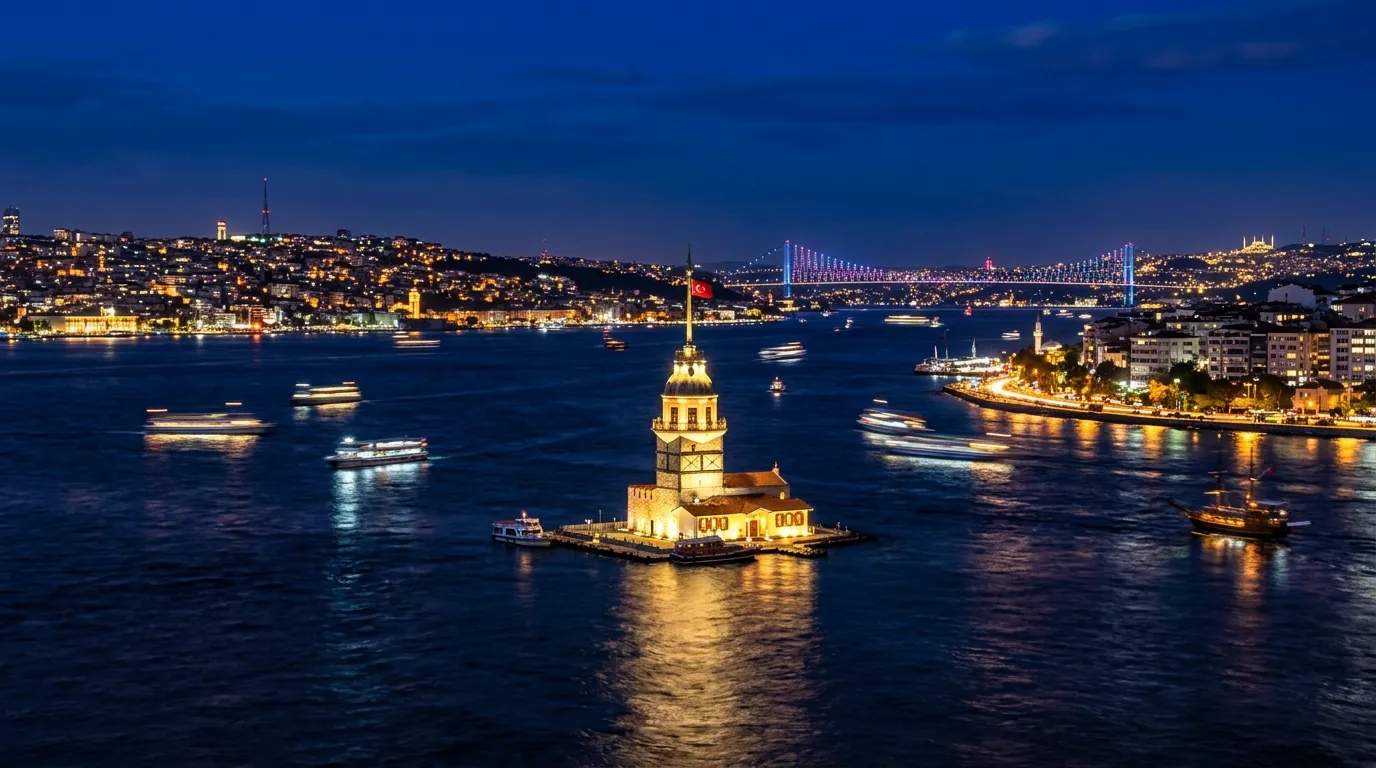
Istanbul night tour 2026: Bosphorus dinner cruises, live music, halal restaurants, family activities, night safety, and late transport for Gulf visitors.
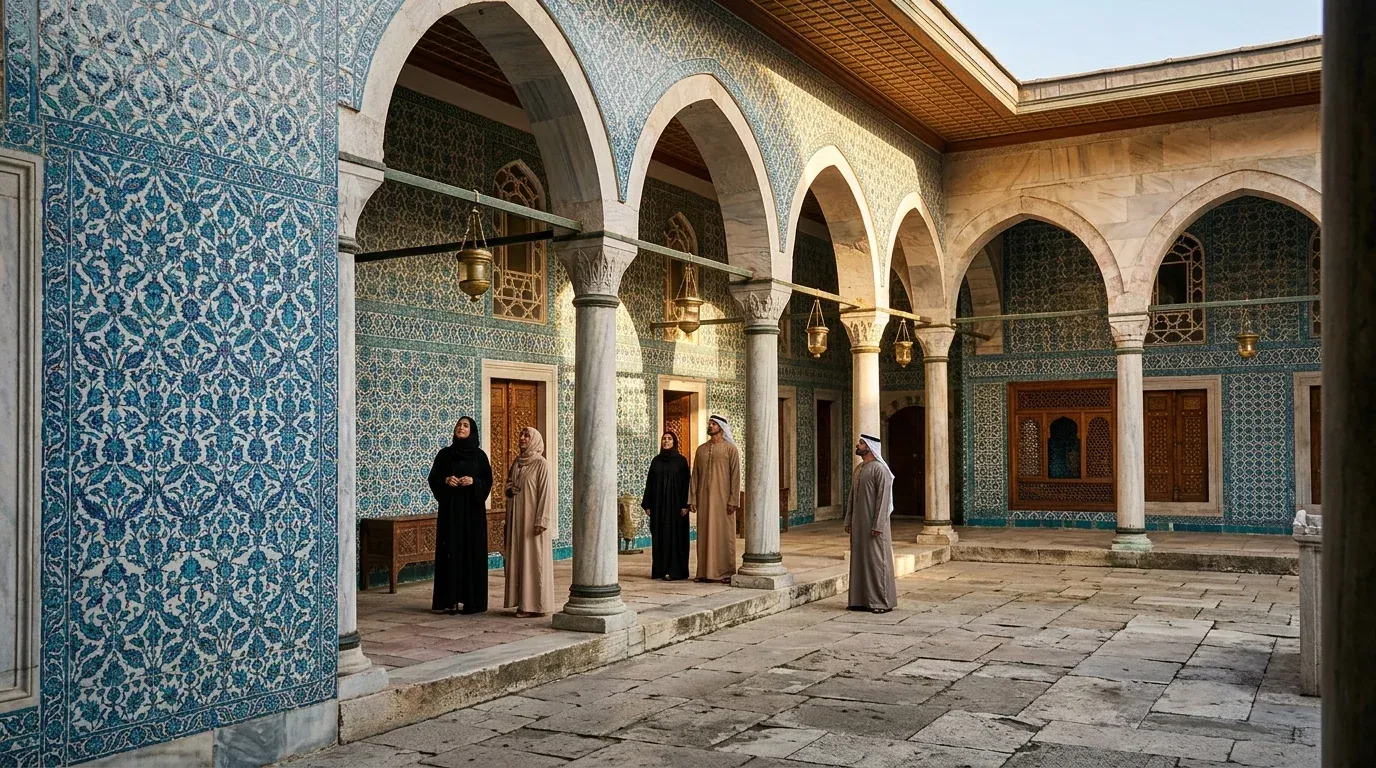
Istanbul historical sites 2026: Hagia Sophia, Topkapi, the Blue Mosque, the Grand Bazaar and more, with tickets, a 3-day plan and tips for Gulf families.
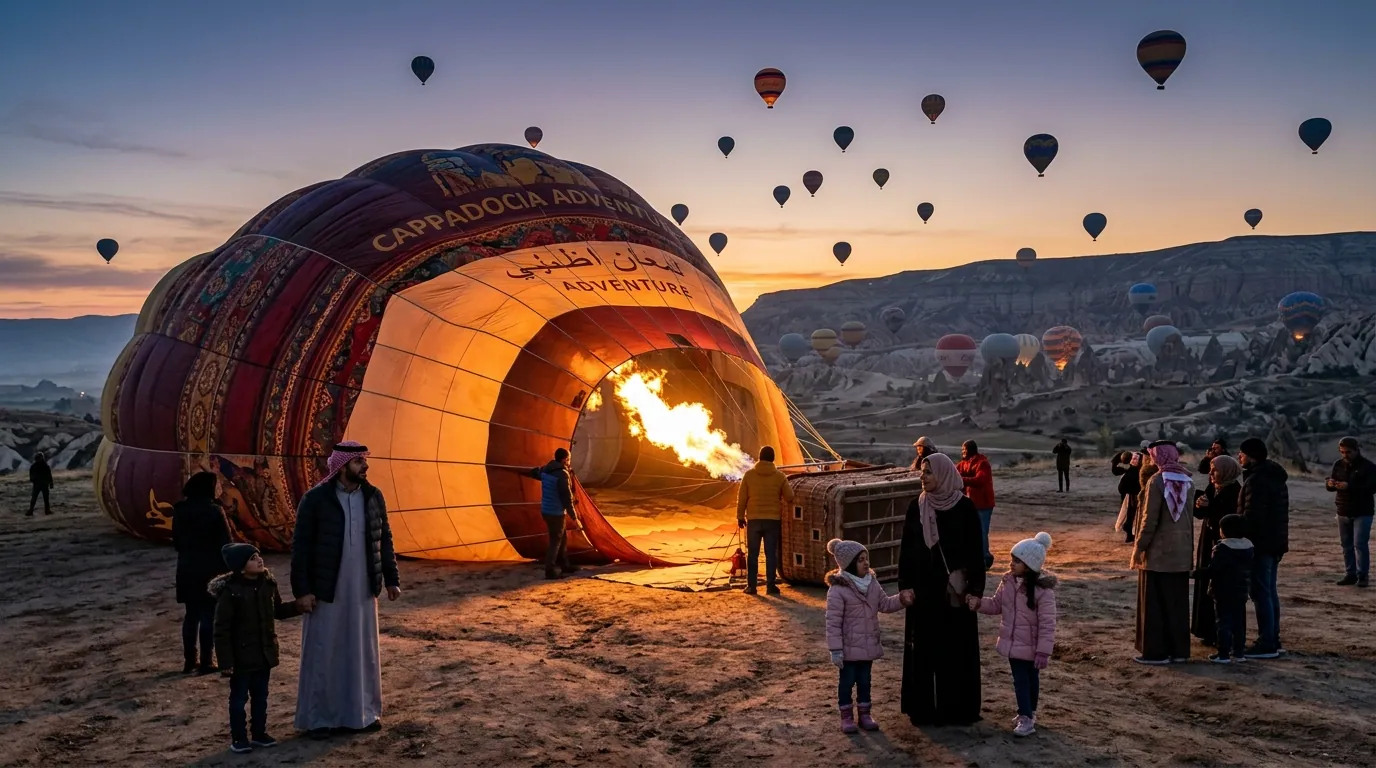
Cappadocia balloon tour 2026: prices by category, dawn takeoff, safety rules, best season for Gulf families, booking window, and cancellation policy.
Ready to explore Turkey?
Voyago brings together hotels, tours and transfers to help you plan the perfect trip to Turkey.