
Quick Answer for Gulf Visitors
Can GCC citizens enter Turkey without a visa? Yes; holders of ordinary passports from all six Gulf Cooperation Council states enter Turkey for tourism without a pre-arranged visa, with a stay of up to 90 days granted on arrival within any 180-day window under the bilateral agreements in force.
What documents are needed on arrival? A passport valid for at least six months, a return or onward ticket, and proof of accommodation such as a hotel confirmation. No entry fee applies to exempt travellers.
What about GCC residents of other nationalities? The exemption follows your citizenship, not your residence; a resident of Saudi Arabia or the UAE whose nationality requires a visa must obtain the e-Visa or a sticker visa accordingly — details in the Turkey visa guide for Saudi travellers.
Book your hotel on Voyago · Private airport pickup · Tours in Istanbul and Antalya
Who Enters Turkey Without a Visa?
Turkey grants visa exemptions to a large group of countries, and the six GCC states are among the principal beneficiaries: Saudi Arabia, the UAE, Qatar, Kuwait, Bahrain and Oman all have arrangements exempting ordinary passport holders from visas for short tourist visits. This status has made Turkey one of the easiest destinations for Gulf families: no complicated forms, no embassy appointments and no fees before travel.
| Nationality | Exemption (ordinary passport) | Length of stay | Notes |
|---|---|---|---|
| Saudi Arabia | Yes | Up to 90 days in 180 | Ankara and Riyadh announced expanded facilitation in 2026 |
| UAE | Yes | Up to 90 days in 180 | No entry fee |
| Qatar | Yes | Up to 90 days in 180 | Reciprocal exemption agreement |
| Kuwait | Yes | Up to 90 days in 180 | Covers tourist and family visits |
| Bahrain | Yes | Up to 90 days in 180 | Covers short visits |
| Oman | Yes | Up to 90 days in 180 | Covers tourist visits |
These rules apply to ordinary passports; diplomatic and special passports usually enjoy broader arrangements. Because policies evolve, always confirm on the official Turkish Ministry of Foreign Affairs page about a week before travel — the ministry's visa information page is the final reference, and checking it takes under two minutes.
A question that recurs every season: does the exemption guarantee entry? The exemption only spares you the advance visa; the final entry decision always rests with the border officer, as in every country. In practice this is a formality for travellers with clean documents, but arriving with a valid passport and a return ticket keeps the process smooth and uneventful. Note that validity is counted from your date of entry, not your booking date: a passport expiring in five months and three weeks may be fine for this month's trip and rejected for next month's, so renew early if the six-month buffer is tight.
What Does Visa-Free Entry Look Like in Practice?
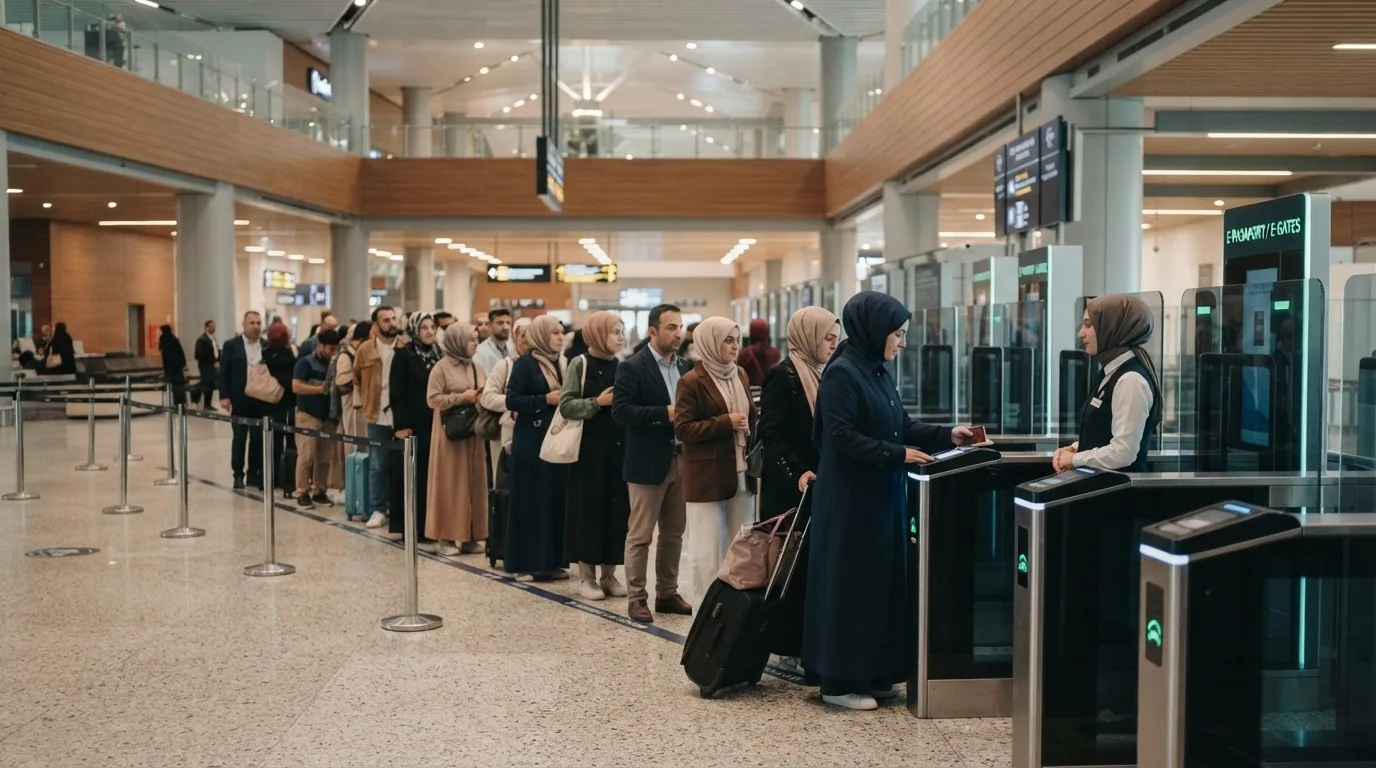
On arrival at Istanbul, Antalya or Trabzon airports you join the visitors' passport line, and the officer stamps your entry with the start date of your stay, possibly asking about the length and purpose of your visit. There is no extra form and no fee; being exempt means your process is identical to any European traveller's. Keep your passport handy on the first night, because some hotels record the entry stamp at check-in.
A practical tip: photograph your passport page and the entry stamp the moment you receive it. That photo simplifies later steps — apartment rentals, tour bookings, SIM registration — and spares you carrying the original everywhere. If you arrive at Istanbul's Sabiha Gokcen airport, allow an extra half hour for passport queues during the busy summer evenings.

Your arrival time shapes how fast the process runs: early morning and midday are calmer than evening peaks when Gulf flights stack up. Budget thirty minutes for passport control and thirty for luggage, and if you have a connecting domestic flight leave at least three hours in high season. travellers entering through land or sea borders find the same procedure but fewer counters — patience there is a well-known summer virtue.
The 90-in-180 Rule: How the Counting Works
The exemption does not grant 90 days per visit; it grants 90 days inside a rolling 180-day window. In plain terms: look back at the last six months from today, and your total days in Turkey within that period must not exceed 90. A visitor who spends two summer months in Turkey and returns two months later may find the remaining balance smaller than expected, and exceeding it invites an exit fine and, for repeat cases, a temporary entry ban.
A worked example: a visitor arrives on 20 May, stays sixty days until mid-August, then plans a return in October. The rolling window still counts all those summer days, so only about thirty days remain for the October trip. Anyone planning repeated visits or a long stay should read the visa run from Turkey guide to understand the lawful alternatives.
Entry Stamp Versus Residence Permit: Terms Visitors Confuse
The Turkish system distinguishes three states that travellers routinely mix up. First, the exemption stamp you receive at passport control: a temporary tourism stay that cannot be extended inside Turkey. Second, the e-Visa or sticker visa issued before travel, usually single-period and non-extendable. Third, the short- or long-term residence permit issued for a reason such as property ownership or study, a completely different process from the tourism stamp. Confusing them produces classic mistakes: assuming you can extend from inside Turkey and overstaying, or relying on a GCC residence card only to discover at the airport that assessment follows your nationality. Make it your rule: your stamp is for visiting, and any wish to stay longer needs an official permit before it expires — not after.
A seasonal story repeats itself in travel agencies: a family books three summer months in Istanbul on the exemption, then discovers a week before departure that the stamp grants only ninety non-extendable days, forcing a costly rework of flights and hotels. The lesson: fix your number of nights before booking, keep your plans inside the available balance, and remember that arrival and departure days usually count as full days.
GCC Residents of Other Nationalities: What Applies?
The Gulf exemption is tied to citizenship, not residence. A resident of Saudi Arabia, the UAE or Qatar holding, say, Egyptian, Pakistani, Indian or Bangladeshi nationality is assessed by Turkish rules for that nationality. Many of these nationalities qualify for the e-Visa under simplified conditions, and some benefit from facilitation when holding a valid residence permit or visa from advanced countries. The golden rule: check your nationality's page on the official e-Visa portal before buying tickets; the answer arrives within minutes.
Three tips shorten the residents' path. First, apply for the e-Visa at least two days before buying tickets, so an eligibility surprise never follows a paid booking. Second, confirm your passport is valid six months from your expected entry date, not your application date — a requirement that catches many applicants. Third, keep an approved copy of the visa on both your phone and email; systems usually suffice, but a dead battery at the inspection desk is a scene no traveller wants. If you are planning a full itinerary after the visa, the comprehensive Turkey guide is an excellent starting point.
Exemption vs e-Visa: A Quick Comparison
| Criterion | Visa-free entry | e-Visa |
|---|---|---|
| Eligibility | Specified nationalities incl. the GCC | Listed nationalities with conditions |
| Where issued | Stamp on arrival | Online before travel |
| Typical duration | Up to 90 days in 180 | Usually 30 days |
| Fee | None | Varies by nationality |
| Processing time | Minutes at passport control | Minutes online |
| Allowed purpose | Tourism, family visits, short business | Tourism and short business |
The choice is usually settled by your nationality rather than preference; but dual-passport holders who have both options should note that the exemption suits longer stays while the e-Visa comfortably covers a standard twenty-day visit. In both cases the same arrival documents decide how smoothly the border conversation goes.
What Is Asked of You at the Border?
The border officer may verify three things: a passport valid six months or more, a ticket leaving within your permitted stay, and the means to cover your visit. Usually nothing beyond the passport is requested, but in peak seasons officers review samples of arriving passengers. Preparation ends any discussion: carry your hotel confirmation printed or on your phone, your return booking, and a credit card in your name. For families: book one room under one confirmation so every name appears on the same document.
Once the stamp is in, the practical half of the trip begins: collecting bags and transferring to your accommodation. Families arriving with children and winter luggage generally prefer a pre-arranged private airport pickup over the taxi queue, and anyone reviewing the best districts before choosing a hotel will find detailed options in the Istanbul hotel booking guide.
When the Exemption Is Not Enough?
The exemption covers tourism, family visits and short business trips; it does not cover study, employment or permanent residence — those require other permit types managed through official gateways such as the Turkish government portal. Likewise, anyone intending more than ninety continuous days — property owners spending an entire summer in Turkey, for instance — needs a property or long-term residence arrangement instead of leaning on the tourism stamp. The rule: an entry stamp is not a residence permit, and every overrun accumulates in the system, complicating future visits.
Practical Info for Gulf Visitors
| Item | Details |
|---|---|
| Passport validity | At least six months from entry |
| Length of stay | 90 days within a 180-day window |
| Entry fee | None for exempt travellers |
| Documents worth carrying | Hotel confirmation + return ticket |
| Children | Individual passport for every child, no exceptions |
| Extending the stay | Not available for the exemption stamp |
| Official reference | e-Visa portal and Ministry of Foreign Affairs |
| Trip planning | Travel to Turkey guide |
FAQ (12 Questions)
- Do I need to print any form before travelling? No; there is no form for exempt travellers. Your passport and tickets suffice, though a printed hotel confirmation is a welcome backup that shortens any question at the desk.
- Does an infant count under the 90-day rule? Yes; every traveller receives an individual stamp regardless of age, and children need their own valid passports matching their parents' validity.
- Can I enter several times a year? Yes, as long as your total days within any rolling 180-day window do not exceed 90; frequency is fine, duration is the deciding factor.
- Can I work on a temporary basis under the tourism stamp? No; any paid work requires an official work permit. The tourism stamp is for visits, and violations can end in an entry ban.
- What if I overstay by a single day? A fine is imposed at departure and grows with the length of the overrun; the breach is recorded and may affect future entries. One day usually passes with a modest fine.
- Does a GCC residence card replace a visa for non-citizens? No; assessment follows your nationality. Check your nationality's page on the official evisa.gov.tr portal before booking.
- Will my luggage be inspected on arrival? Security screening is standard as at any airport; customs focuses on commercial goods and large currency amounts. Family personal effects raise no questions.
- Can I enter overland from Georgia or Bulgaria on the same exemption? Yes; the exemption applies equally at land, sea and air crossings, with longer summer queues at land borders.
- Do hotels need the entry stamp? Some hotels ask to see it at check-in for registration purposes, so keep the passport handy the first night, then keep a photo of the stamp on your phone.
- Is travel insurance mandatory? Not mandatory for exempt travellers but strongly recommended; a private clinic visit without cover can carry surprising bills, and premium credit cards often include travel cover.
- Is there an Arabic information desk at the airports? Istanbul and Antalya display Arabic signage in season, staff generally assist in English, and translation apps bridge any gaps.
- What if the officer refuses entry? Refusal is rare for exempt travellers and usually tied to a document flaw or a prior overrun; ask politely for the reason, request an interpreter if needed, and present proof of return and accommodation.
Conclusion
Turkey's entry arrangements in 2026 favour the Gulf visitor: a passport valid six months opens 90 tourist days within every six-month window, with no fees and no advance applications. The successful trip checklist is three words: valid passport, return ticket, hotel confirmation. Anyone needing a longer stay, or visiting on a non-exempt nationality, will find the official portal settles their route in minutes. Plan the rest of your trip with confidence and lock in your accommodation and transfers early for the high season.
Search hotels across Turkey · Arrange your airport pickup · Choose your first tour
Sources
- Turkish Ministry of Foreign Affairs — official visa information for foreigners and the exempt-countries list.
- Turkey e-Visa portal — nationality-by-nationality eligibility checks and e-Visa issuance.
- Turkish government gateway — official services for residents and visitors.
- Is travel to Turkey allowed? — current travel status and guidance for Gulf visitors.
Related travel guides

Ayder highlands 5-day itinerary 2026: a day-by-day plan for Arab families covering thermal pools, valleys, and Trabzon.

Ayder Trabzon distance 5-day itinerary 2026: a day-by-day plan for Arab families covering the transfer route.

Ayder Turkey weather 2026: monthly averages, rain patterns, best months to visit, and packing tips for Gulf families.
Ready to explore Turkey?
Voyago brings together hotels, tours and transfers to help you plan the perfect trip to Turkey.