
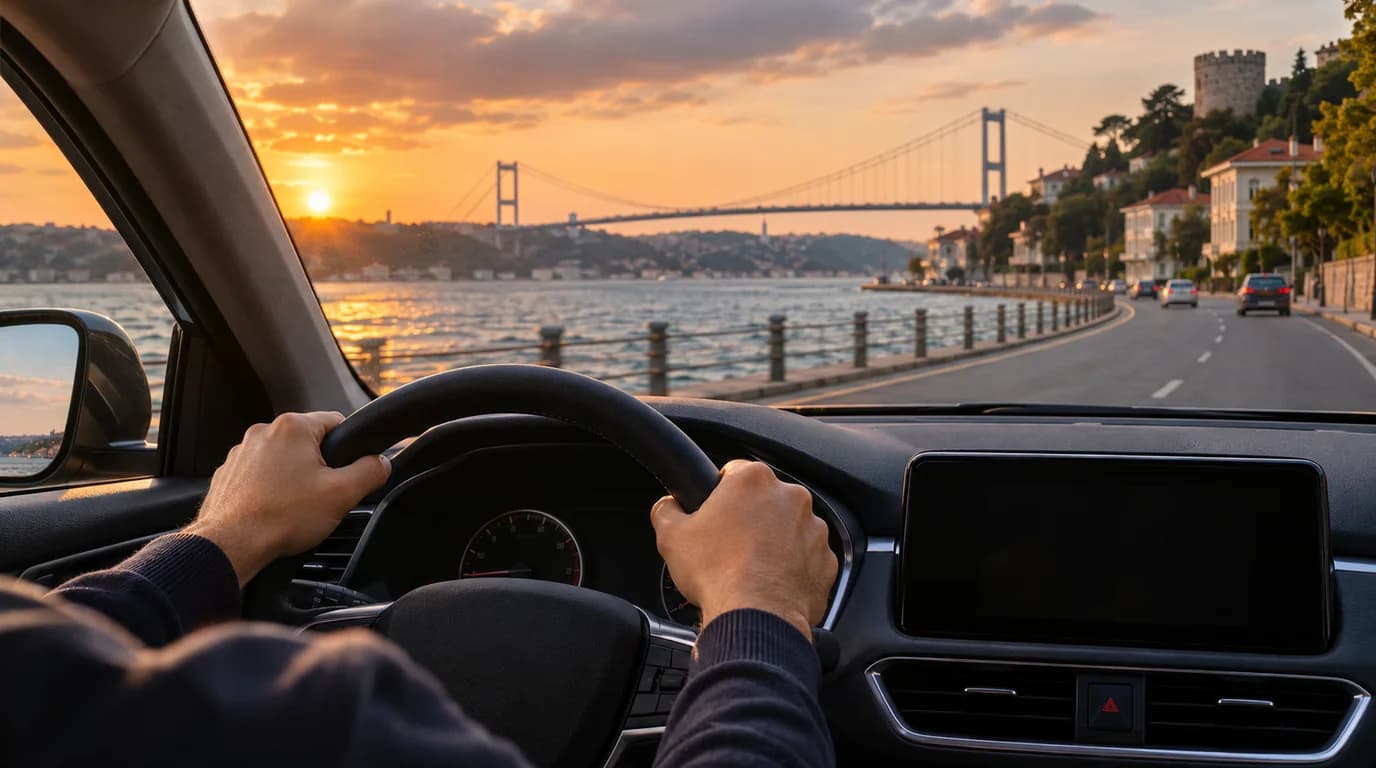
Driving in Istanbul at a Glance
Foreign visitors may drive in Istanbul on the licence issued in their own country for up to six months from their date of entry into Turkey, according to the Turkish Ministry of Foreign Affairs (checked 12 November 2026). Traffic drives on the right, the passenger-car limit is 50 km/h in built-up areas, and bridge, motorway and tunnel tolls are collected electronically through HGS, with no cash booths.
The harder question is whether you should drive at all. Inside the historic peninsula and around Beyoğlu, a car is usually slower than the tram, the metro or a driver. For day trips out of the city, to Sapanca, Bursa or the Black Sea coast, a rental car gives you far more freedom. This page covers licences, speed limits, Bosphorus crossings, parking, airport pick-up and family safety, so you can decide which days need a car.
Should You Drive in Istanbul?
Drive when you leave the centre, not when you sightsee inside it. The historic peninsula (Sultanahmet, Eminönü, the Grand Bazaar) has narrow streets, limited parking and good rail links, so walking, the tram and short taxi or transfer rides work better there. The same applies to Beyoğlu, Galata and Taksim.
A car makes sense in three situations:
- Day trips out of the city: Sapanca and Maşukiye, Bursa and Uludağ, Şile and Ağva, or the Belgrade Forest. Public transport to these places is slower and less flexible, especially with children.
- Staying outside the centre: if your accommodation is on the Asian side, near the airport or in a suburb without a rail line, a car can save time on daily trips.
- Large families with luggage: moving a family of five between several bases is easier in one car than in two taxis.
A good split for most Gulf families: use a private transfer from the airport to a central hotel, explore the old city on foot and by tram, then pick up a car only for the days you leave Istanbul. Our Istanbul travel guide helps you map which sights sit close together.
Licence and Documents
The Ministry of Foreign Affairs states that foreign nationals can drive with a licence obtained abroad for at most six months from the date they entered Turkey; after that, the licence must be exchanged for a Turkish one (MFA traffic rules page, checked 12 November 2026). For a holiday visitor, the six-month window is rarely a problem.
To rent a car, you normally need:
- Your original driving licence (a copy is not accepted).
- A passport.
- A credit card in the main driver's name for the deposit.
- An international driving permit if your licence is not in the Latin alphabet; some branches ask for one at hand-over.
Most rental offers set a minimum age of 21 for economy and midsize cars and 25-27 for luxury cars and SUVs, often with a licence held for one to three years. The details for each car are shown before you book on Voyago car rental in Istanbul, where deposits, insurance and fuel policy are also listed.
Speed Limits and Cameras
The General Directorate of Highways (KGM) publishes these limits for passenger cars (checked 12 November 2026):
| Road type | Passenger car limit |
|---|---|
| Built-up areas | 50 km/h |
| Two-lane roads outside settlements | 90 km/h |
| Divided roads | 110 km/h |
| KGM motorways | 130 km/h |
| Build-operate-transfer motorways | 140 km/h |
| Eurasia Tunnel | 70 km/h |
Sources: KGM speed limits; Eurasia Tunnel FAQ for the tunnel limit.
Signs on a specific road can set a lower limit, and urban motorway sections in Istanbul can be signposted below the national maximum. Follow the posted sign, not the table. Speed cameras are common, and on a rental car any fine reaches the driver who signed the contract.
Crossing the Bosphorus: Bridges, Tunnel and Tolls
You have four road crossings between Europe and Asia: the 15 July Martyrs Bridge, the Fatih Sultan Mehmet Bridge, the Yavuz Sultan Selim Bridge in the north and the Eurasia Tunnel under the sea. All of them charge tolls, and none take cash at the barrier.
Payment works through HGS, the electronic toll system. Rental cars carry an HGS tag, and the rental company passes the tolls on to you at the end of the rental or offers a toll package when you book. Ask at hand-over how your car's tolls are settled, because passing without a valid tag counts as a violation. Toll amounts change during the year, so we do not list them here.
The Eurasia Tunnel has its own rules, published on its official FAQ (checked 12 November 2026):
- It is for light vehicles only; vehicles taller than 2.80 m, bicycles, scooters and pedestrians are not allowed.
- It is open 24 hours a day, and the toll is charged in one direction per vehicle.
- On the European side it connects with Kazlıçeşme, Kocamustafapaşa, Yenikapı and Kumkapı; on the Asian side with Acıbadem, Uzunçayır and Göztepe.
- The maximum speed inside is 70 km/h.
- An unpaid toll can be paid within 15 days without a penalty; after that, fines apply.
For a family staying in Sultanahmet and visiting the Asian side, the tunnel is often the most direct road link.
Parking in Istanbul
Parking in the centre is limited and usually paid. İSPARK, the parking company of Istanbul Metropolitan Municipality, runs multi-storey, underground and street car parks across the city, plus park-and-ride sites where you can leave the car and continue by public transport. You can pay through its İSPARK Mobil app or online, and its help line is 153 (İSPARK, checked 12 November 2026).
Practical tips:
- Ask your hotel first. Many central hotels have no parking or only a few paid spaces; confirm before you book a car for the whole stay.
- Use park-and-ride for the old city. Leaving the car outside the historic peninsula and taking the metro or tram avoids the narrowest streets.
- Shopping centres usually have large garages and make an easy family stop.
- Never block a lane or a tram line. Illegally parked cars can be towed, and recovering a towed rental car costs time on a short trip.
Picking Up a Car at IST or SAW
You can collect a rental car at Istanbul Airport (IST) or Sabiha Gökçen Airport (SAW), both of which are pick-up points alongside city branches. Collecting at the airport makes most sense when you head straight out of Istanbul, for example to Sapanca or Bursa. If you are staying in the old city for the first days, a transfer to the hotel and a later pick-up usually works better than paying for a car that sits in a car park.
Not sure which airport you are flying into? Our IST vs SAW guide explains the difference.
Most offers use a full-to-full fuel policy: you get the car with a full tank and return it full. Some include unlimited mileage, others set a daily limit; both are shown on the car's card before you pay.
Day Trips Where a Car Pays Off
Three trips show what a car adds:
- Sapanca and Maşukiye: lake, forest and riverside restaurants east of the city. Our Sapanca and Maşukiye guide helps you choose between a day trip and two nights.
- Bursa and Uludağ: the old Ottoman capital and its mountain. The Istanbul to Bursa guide compares road, ferry and bus.
- Şile and Ağva: the Black Sea coast north-east of the city, quiet outside summer weekends.
If you would rather not drive, Voyago's tours from Bursa cover the city, Uludağ, Cumalıkızık and the Kartepe–Maşukiye–Sapanca route with a driver.
Family Safety and Accidents
Seat belts are compulsory, and Turkish rules require an appropriate child restraint for small children. Add a child seat to your rental booking for every child who needs one, and check the fitting before you leave the car park; the driving in Turkey questions page summarises the child seat rule and other basics.
If you have an accident, make the scene safe, call 112 if anyone is hurt, then call the rental company's emergency number on your contract. Ask for an official accident report before moving the car: without it, the collision cover usually does not apply. Photograph the damage and both vehicles' plates.
FAQ
Can I drive in Istanbul with a Saudi, Emirati or Kuwaiti licence?
Yes. Foreign nationals can drive on a licence from their own country for up to six months from entry, per the Ministry of Foreign Affairs. If your licence is not in the Latin alphabet, carry an international driving permit as well.
Is driving in Istanbul difficult?
The centre is dense, with heavy traffic at peak times, narrow streets in the old city and limited parking. Driving outside the centre and on intercity roads is much easier, which is why many visitors only rent a car for day trips.
How do I pay tolls in a rental car?
Through the car's HGS tag. There is no cash payment at bridges, motorways or the Eurasia Tunnel, and the rental company charges the tolls at the end or sells a toll package at booking.
Can I use the Eurasia Tunnel in a rental car?
Yes, if the car is a light vehicle under 2.80 m tall, which covers normal rental cars. The speed limit inside is 70 km/h and the toll is charged in one direction.
Where can I park near Sultanahmet?
Spaces are scarce. Ask your hotel, use an İSPARK car park, or leave the car at a park-and-ride site and continue by tram.
Should I rent at the airport or in the city?
Rent at IST or SAW if you leave Istanbul straight away. If you spend the first days in the old city, take a transfer and collect the car later.
Conclusion
Driving in Istanbul is legal and straightforward on a foreign licence, but a car pays off mainly outside the centre: for Sapanca, Bursa, the Black Sea coast or a base far from the rail lines. Use transfers and the tram in the old city, then rent a car in Istanbul for the days you leave it, with the HGS tag, the posted speed limits and your parking plan sorted before you set off.
Sources
- Republic of Türkiye Ministry of Foreign Affairs, traffic rules and foreign licences: https://www.mfa.gov.tr/yurtdisinda-yasayan-vatandaslarimizin_-ulkemize-izine-geldiklerinde-yararlanabilecekleri-trafik-kural-ve-bilgileri-.tr.mfa (checked 12 November 2026)
- General Directorate of Highways (KGM), speed limits: https://www.kgm.gov.tr/Sayfalar/KGM/SiteTr/Trafik/HizSinirlari.aspx (checked 12 November 2026)
- Eurasia Tunnel, official FAQ (vehicles, hours, payment, speed limit, connections): http://www.avrasyatuneli.com/en/faq/ (checked 12 November 2026)
- İSPARK, Istanbul Metropolitan Municipality parking: https://ispark.istanbul/ (checked 12 November 2026)
Related travel guides
A metro or tram ride costs 46.20 TL by Istanbulkart against 65 TL for a single e-ticket (tariff from 20 July 2026). Rail, ferry and taxi fares, transfers, tips.
Dammam to Istanbul takes about 4 hours nonstop: flynas lists 4h 15m to SAW, Turkish Airlines about 4h 30m on its IST route. Airlines, airports, transfers.

Mostly yes: restaurant meat in Istanbul is halal by default; alcohol is what to check. Halal food district by district, family picks, prices and mosques.
Ready to explore Turkey?
Voyago brings together airport transfers, guided tours and car rental to help you plan the perfect trip to Turkey.